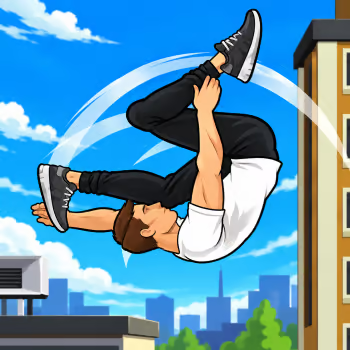
Swagflip turns a single jump into a test of timing, rotation, and nerve. Your athlete launches from rooftops, platforms, basketball hoops, and other urban spots, but getting into the air is only the beginning.
Every stunt has two competing goals. You want enough airtime to perform an impressive flip, yet you still need to bring the character back into position before reaching the ground.
Hold the rotation too long and you can overspin. Stop too early and the landing may fall apart. Add another trick and your score can improve, but so does the chance of ending the attempt with a ragdoll crash.
Four Moments Decide Every Jump
A successful Swagflip attempt can be understood as four separate moments: crouch, launch, tuck, and land.
First, hold the input to crouch and prepare the jump.
Release to launch your character into the air.
Once airborne, hold again to tuck the body and increase the rotation. This is where you control how far the flip develops.
Finally, release before reaching the ground so the character can open up and prepare for the landing.
The controls are simple, but the timing between these four moments changes depending on the height, distance, and landing area of each stunt.
Controls
Desktop
- Click and Hold: Crouch and prepare the jump
- Release: Jump
- Click and Hold in the Air: Tuck and rotate
- Release Again: Open up and prepare to land
Mobile
- Tap and Hold: Crouch
- Release: Jump
- Tap and Hold in the Air: Tuck and rotate
- Release: Prepare for landing
The Flip Is Only Half the Stunt
It is tempting to focus entirely on how many rotations you can complete.
That is usually how a good jump turns into a bad landing.
Before attempting another rotation, check how much airtime remains. If your character is already descending quickly, continuing to tuck may leave too little time to straighten the body.
The goal is to finish the rotation with enough height left to prepare the feet for contact with the ground.
This creates the main risk-versus-reward decision in Swagflip: more rotation can produce a more impressive stunt, but a simpler flip with a controlled landing is often the better choice.
How to Stop Over-Rotating
Over-rotation usually happens because you keep the character tucked for too long.
Instead of waiting until the athlete is almost touching the ground, release the rotation earlier and watch how the body continues moving through the air.
Momentum does not disappear immediately when you release.
This means you should start preparing for the landing before the character reaches the exact upright position you want.
If you repeatedly land on the back, try releasing earlier on the next attempt.
If you consistently land short of a complete rotation, stay tucked slightly longer.
Making these small timing adjustments is much more effective than completely changing your technique after every failed attempt.
From Basic Backflips to Trick Combos
Once you can reliably complete a basic flip, you can start experimenting with more advanced movements.
Swagflip includes aerial tricks such as Pike, Layout, and Viper, giving you ways to build more stylish combinations instead of repeating the same basic rotation.
The safest approach is to add complexity gradually.
First learn the launch.
Then learn the amount of rotation required for a clean landing.
Only after those two parts become consistent should you start adding additional tricks or rotations.
Longer combinations can improve your score, but every extra movement uses airtime that would otherwise be available for recovering and preparing to land.
Use the Landing to Judge Your Timing
A failed landing tells you what went wrong with the rest of the jump.
Landing on your back usually suggests that you rotated too far.
Coming down before completing the flip often means you stopped the rotation too early or did not create enough airtime.
Overshooting the target can indicate that the launch itself was too strong, even if the rotation looked perfect.
This makes each failed attempt useful.
Instead of immediately repeating exactly the same input, look at how the character crashed and adjust one part of the next attempt.
Why the Ragdoll Physics Matter
Swagflip uses ragdoll physics, so your character does not simply switch between fixed jumping animations.
The body reacts to rotation, momentum, landing angle, and collisions.
That is why two attempts that look almost identical can end differently if the timing changes slightly.
The physics also make crashes part of the experience, but they provide useful feedback. An awkward landing often makes it obvious whether you needed less rotation, more height, or an earlier release.
As the jumps become more demanding, understanding these reactions becomes more valuable than simply clicking faster.
More Games for Timing and Physics Fans
If you enjoy the unpredictable physics and crashes in Swagflip, Ragdoll Hit shifts the ragdoll mechanics into combat.
Try Stickman Hook if you want another game built around momentum, timing, and controlling movement through the air.
Flip Bros is a good next choice if the flipping mechanic itself is what you enjoy most.
For a different type of physics challenge, Drive Mad replaces the athlete with unusual vehicles and makes balance the key to reaching the finish.
If you prefer parkour where movement through the course matters more than aerial tricks, Vex 7 offers a more traditional obstacle-platforming challenge.