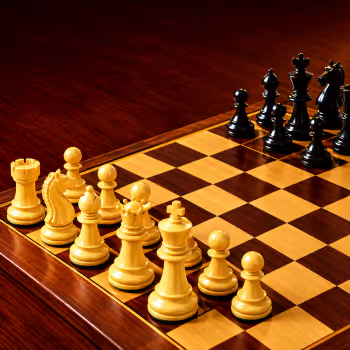
Master Chess is a classic strategy game where every move can change the outcome of the match. Play chess against the computer or challenge a friend on the same device as you try to outthink your opponent and deliver checkmate.
Developed by Code This Lab, Master Chess brings traditional chess rules to a clean, easy-to-use digital board. You can choose between three computer difficulty levels, making it suitable for beginners learning the basics and experienced players looking for a tougher challenge.
Unlike fast-paced action games, Master Chess rewards careful planning, patience, and the ability to recognize threats before they become dangerous.
Choose Your Opponent and Start Thinking
Master Chess offers two main ways to play.
Play Against the Computer
Challenge an AI opponent and select a difficulty level that matches your experience.
-
Easy: A good starting point for learning piece movements and basic strategies.
-
Medium: A more demanding challenge that encourages you to think ahead.
-
Hard: A tougher opponent that requires careful planning and fewer mistakes.
Two-Player Mode
Challenge a friend using the same computer, tablet, or mobile device.
Both players take turns moving their pieces on the shared board.
This mode is ideal for friendly competitions, practicing new openings, or introducing someone to chess.
Regardless of your opponent, the objective remains the same: checkmate the enemy king.
Controls
Desktop
Mobile
When you select a piece, the game highlights its available legal moves.
This feature makes it easier to understand where each piece can travel, especially when you are still learning the rules.
You cannot move a piece to a square that would leave your own king in check.
Learn How Every Chess Piece Moves
Master Chess follows the traditional rules of chess.
Each player begins with 16 pieces: one king, one queen, two rooks, two bishops, two knights, and eight pawns.
Understanding their movements is the first step toward building a winning strategy.
King: Moves one square in any direction, provided the destination is safe.
Queen: Moves any number of squares horizontally, vertically, or diagonally.
Rook: Travels along rows and columns.
Bishop: Moves diagonally across the board.
Knight: Moves in an L-shaped pattern and can jump over other pieces.
Pawn: Usually advances one square forward, with the option to move two squares on its first move. It captures diagonally.
Every piece has a different purpose.
The queen is powerful because of its movement range, while knights can create unexpected threats.
Pawns may seem weak individually, but they help control important squares and protect more valuable pieces.
A strong player understands how these pieces work together.
Winning Means Checkmate, Not Capturing Everything
A common beginner mistake is focusing entirely on capturing the opponent's pieces.
However, chess is not won by collecting the most material.
Your actual objective is to checkmate the opposing king.
A king is in check when it is threatened by an enemy piece.
The defending player must respond by moving the king, blocking the attack, or capturing the attacking piece when possible.
Checkmate occurs when the king is in check and there is no legal move that removes the threat.
The game then ends immediately.
You can sometimes deliver checkmate even when your opponent still has several powerful pieces remaining.
This is why positioning and coordination are often more important than the number of pieces you capture.
Control the Center Before Attacking
One of the most useful opening principles in chess is controlling the center of the board.
The four central squares are e4, d4, e5, and d5.
Pieces placed near the center often have more opportunities to move and influence the game.
For example, opening with the king's pawn to e4 can create space for your bishop and queen.
Moving the queen's pawn to d4 is another common way to challenge the center.
After advancing a central pawn, develop your knights and bishops to useful positions.
Avoid making unnecessary pawn moves while your major pieces remain trapped on their starting squares.
A good opening does not need to produce an immediate attack.
Its purpose is to give your pieces room to operate and prepare for the middle game.
Why You Should Protect Your King Early
Keeping your king safe is essential, even when your opponent has not started an obvious attack.
One useful defensive technique is castling.
Castling is a special move involving the king and a rook.
It helps move your king away from the center while bringing a rook closer to active play.
However, castling is only legal under certain conditions.
Neither the king nor the chosen rook may have moved previously.
The squares between them must be empty, and the king cannot castle while in check, through an attacked square, or into check.
When castling is available, it can help create a safer position before the middle game becomes more complicated.
Do not wait until your king is already surrounded by threats before thinking about defense.
Three Tactical Ideas That Win Pieces
As you become comfortable with the rules, start looking for tactical opportunities.
Fork
A fork occurs when one piece attacks two or more enemy pieces at the same time.
Knights are particularly effective at creating forks because of their unusual movement pattern.
For example, a knight may threaten the opposing king and queen simultaneously.
Pin
A pin occurs when moving a piece would expose a more valuable piece behind it.
A bishop may pin a knight against the queen, making the knight difficult to move safely.
Skewer
A skewer attacks a valuable piece positioned in front of another piece.
When the more valuable piece moves away, the piece behind it becomes vulnerable.
Learning to recognize these patterns can help you win material without relying on random exchanges.
Think One Move Further Than Your Opponent
Before moving a piece, ask yourself three questions.
What is my opponent threatening?
Look at the pieces your opponent attacked with their previous move.
An unprotected bishop or knight may be in immediate danger.
What happens after my move?
Imagine your opponent's strongest response.
A move that looks good at first may allow an unexpected capture or check.
Can I improve my position instead?
Sometimes the best decision is developing a piece, defending a weak square, or improving your king's safety rather than launching an attack.
You do not need to calculate ten moves ahead to become a better chess player.
Consistently checking one or two possible responses can prevent many common mistakes.
Pawn Promotion Can Change the Endgame
Pawns become especially important when only a few pieces remain on the board.
If a pawn reaches the final rank, it must be promoted to a queen, rook, bishop, or knight.
Promoting to a queen is often the strongest choice because the queen can move in several directions.
However, there are situations where choosing another piece may be strategically useful.
In Master Chess, the promotion interface allows you to select the new piece.
During the endgame, protecting an advancing pawn can be more valuable than chasing an enemy piece across the board.
Your king also becomes more active when the board is less crowded.
Learning how to support your pawns and restrict the opposing king is an important step toward winning more games.
Avoid These Common Chess Mistakes
Moving the queen too early: Bringing your queen into the attack immediately can allow your opponent to develop pieces while repeatedly threatening it.
Ignoring undefended pieces: Before every move, check whether your opponent can capture something for free.
Making the same opening move repeatedly: Moving one piece several times can waste opportunities to develop the rest of your army.
Attacking without a plan: A threat is only useful when it improves your position or forces a meaningful response.
Forgetting king safety: Even a material advantage can disappear if your king becomes vulnerable to checkmate.
Trading pieces automatically: Consider which side benefits from an exchange before capturing.
Playing too quickly: A few extra seconds of calculation can prevent a costly mistake.
The best way to improve is to recognize why a move failed and avoid repeating the same error.
How to Practice Chess More Effectively
If you are new to Master Chess, begin against the computer on Easy difficulty.
Focus on developing your pieces, protecting your king, and avoiding unnecessary captures.
Once you can complete games confidently, increase the difficulty to Medium.
At this stage, pay more attention to tactical opportunities such as forks, pins, and discovered attacks.
When you are ready for a greater challenge, try Hard difficulty.
You can also use Two-Player Mode to compete with a friend and compare different strategies.
After each game, think about the decisions that mattered most.
Did you lose an important piece without compensation?
Did you miss a chance to checkmate?
Did your opponent control the center more effectively?
Reviewing these questions can help you improve even without a dedicated chess training system.
Frequently Asked Questions
Can I play Master Chess against the computer?
Yes. The game includes a single-player mode with three AI difficulty settings.
Can two people play Master Chess together?
Yes. Two players can take turns on the same device.
Is Master Chess suitable for beginners?
Yes. The highlighted legal moves and adjustable computer difficulty make it accessible to players who are learning chess.
How do you win in Master Chess?
You win by placing your opponent's king in checkmate, leaving no legal way to escape the attack.
Can a chess game end in a draw?
Yes. Chess includes draw situations such as stalemate, insufficient mating material, and certain repeated positions.
Does Master Chess support special chess moves?
Yes. The standard game includes rules such as castling, en passant, and pawn promotion.
A Strategy Game Where Every Decision Counts
Master Chess offers a different kind of challenge from games that depend mainly on reaction speed.
You have time to study the board, compare possible moves, and build a plan.
A small positional advantage can eventually become a winning attack.
At the same time, a single careless move can completely change the game.
Whether you are practicing against the computer or competing with a friend, each match offers new opportunities to improve your strategic thinking.
Play Master Chess online for free and see whether you can protect your king, outsmart your opponent, and deliver the final checkmate.