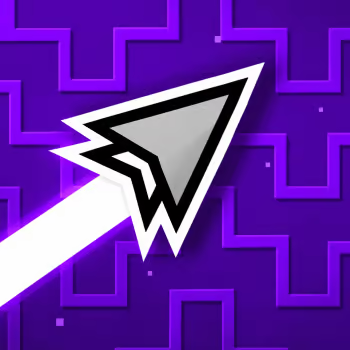
Geometry Dash Wave is a fast-paced skill game built around one of the most challenging movement mechanics in Geometry Dash. Instead of jumping between platforms, you control a glowing wave that travels diagonally through dangerous geometric courses.
Hold the control to climb upward and release it to descend. Every movement creates a sharp zigzag line, making even a small timing mistake potentially dangerous.
As the paths become narrower and obstacles appear closer together, you must learn to control your movement with increasingly precise inputs. Geometry Dash Wave rewards patience, concentration, and the ability to maintain a steady rhythm under pressure.
A Different Kind of Geometry Dash Challenge
Most Geometry Dash games introduce several movement forms, including cubes, ships, and balls.
Geometry Dash Wave takes a more focused approach.
Your main challenge is controlling a wave-shaped icon as it moves automatically through the course.
Unlike a cube that can land on a platform, the wave continuously travels diagonally upward or downward.
There is no ordinary jumping motion.
Instead, you must alternate between holding and releasing the control to guide your character through the available space.
The objective is straightforward: reach the end of the course without colliding with spikes, walls, or other dangerous obstacles.
Controls
Desktop
-
Hold Left Mouse Button: Move diagonally upward
-
Hold Spacebar: Alternative control for moving upward
-
Release: Move diagonally downward
Mobile
Your wave moves forward automatically.
You cannot stop it to wait for an obstacle to disappear. Every decision must be made while the course continues moving.
Why Short Taps Are So Important
The most useful technique in Geometry Dash Wave is learning to make small adjustments.
Holding the button for too long sends your wave upward, potentially causing it to collide with the ceiling or nearby spikes.
Releasing for too long creates the opposite problem.
The wave descends quickly, leaving little time to recover before reaching the floor.
In narrow passages, use short presses followed by short releases.
This creates a smaller zigzag pattern that helps you remain within the safe area.
Imagine moving through a tunnel with hazards above and below.
A large upward movement may immediately cause a crash, while several small corrections can keep your wave near the center.
The goal is not to press as quickly as possible. It is to control the distance traveled during each input.
Reading the Shape of the Tunnel
Geometry Dash Wave becomes much easier when you learn to recognize the route ahead.
Some sections provide wide spaces where longer movements are safe.
Others contain narrow corridors that require much tighter control.
Before entering a difficult passage, look at the position of the next opening.
If the safe route rises, begin climbing early enough to reach it.
If the route descends, release the button before you get too close to the upper obstacles.
Waiting until your wave reaches the edge of a tunnel often leaves insufficient room to correct its direction.
Try to focus on the next two or three obstacles rather than watching only your character.
This gives you more time to prepare for sudden changes in the route.
Mastering the Zigzag Movement
The wave's movement follows a simple pattern, but maintaining a stable zigzag requires practice.
A common beginner mistake is making large corrections whenever the character approaches an obstacle.
For example, you may hold the button too long to avoid spikes below, then release too long to avoid the ceiling.
This creates an unstable movement pattern.
A better approach is to maintain smaller, more consistent changes in direction.
When the route is wide, you can use longer movements to adjust your position.
When the route becomes narrow, reduce the duration of each press.
Over time, you will develop a sense of how far the wave travels during a short input.
That familiarity is essential for surviving more difficult sections.
How to Handle Sudden Direction Changes
Not every obstacle can be passed with a perfectly even zigzag.
Some sections require a quick climb followed by an immediate descent.
Others force you to stay low before rising through a small opening.
The key is preparing your position before reaching the transition.
If a narrow opening appears near the top of the screen, move upward while you still have enough room.
Once you enter the opening, shorten your inputs to avoid hitting the surrounding obstacles.
Avoid making a large correction at the last possible moment.
Because the wave responds immediately when you hold or release, early preparation is often more effective than a rushed reaction.
Practice Mode Helps You Learn Difficult Patterns
Geometry Dash Wave includes a Practice Mode for learning challenging sections.
Instead of treating every mistake as the end of a complete attempt, you can focus on understanding difficult obstacle patterns.
This is especially useful when a narrow passage repeatedly causes you to crash.
Start by identifying exactly where the problem occurs.
Are you climbing too early?
Are you releasing the button too late?
Or are you making a larger correction than the available space allows?
Experiment with small changes until you find a reliable movement pattern.
Repeat the section several times before attempting a complete run.
Practice is most effective when you concentrate on one specific mistake rather than changing your entire approach after every failure.
The Difference Between Wave and Ship Control
Wave movement may initially look similar to flying a ship in Geometry Dash, but the two forms behave differently.
In ship mode, holding the control causes the character to rise, while releasing allows gravity to pull it downward.
The ship's movement is smoother and influenced by its vertical momentum.
Wave mode follows a more direct diagonal path.
Holding sends the wave upward at an angle, while releasing immediately changes its direction downward.
This creates sharp corners instead of the smoother curves associated with ship movement.
As a result, wave sections place greater emphasis on the duration of each input.
Players who are comfortable with ship controls may still need time to adjust to the wave's more immediate response.
Common Mistakes That Cause Crashes
Holding too long: A long press can send your wave into the ceiling before you have time to react.
Releasing too late: Waiting too long to descend can make it impossible to reach the next opening.
Overcorrecting: Large movements are dangerous when the available space is narrow.
Watching only your character: Focusing on the wave instead of the upcoming obstacles reduces your reaction time.
Ignoring the tunnel layout: Different sections require different movement patterns.
Changing your timing randomly: Repeating a reliable pattern is more effective than using completely different inputs on every attempt.
Improving at Geometry Dash Wave is largely about recognizing these mistakes and correcting them one at a time.
A Simple Training Routine for Better Wave Control
If you are struggling to complete difficult sections, try dividing your practice into three stages.
Stage 1: Learn the basic movement
Use wider areas to understand how holding and releasing affects your position.
Practice creating small zigzags without making unnecessary large movements.
Stage 2: Focus on narrow passages
Try to remain near the center of the available space.
Use shorter inputs and avoid approaching the edges unless the route requires it.
Stage 3: Connect difficult sections
Once you can complete individual obstacles consistently, focus on moving smoothly between them.
Pay attention to your position when leaving one passage and entering the next.
The objective is to develop repeatable movement patterns rather than relying entirely on last-second reactions.
Why Geometry Dash Wave Is So Addictive
Geometry Dash Wave creates a challenge where the rules are easy to understand but difficult to master.
You only need to hold and release a button.
However, the distance between success and failure can be extremely small.
Each attempt gives you an opportunity to improve your timing and discover a more reliable path through the obstacles.
The neon visuals and energetic music add intensity to the experience, while quick restarts encourage repeated attempts.
As your control improves, sections that once seemed impossible begin to feel manageable.
That sense of measurable progress is what makes the game rewarding for players who enjoy precision-based challenges.
More Games for Geometry Dash Fans
If you enjoy Geometry Dash Wave, Geometry Dash offers a broader rhythm-platforming experience with different movement forms and obstacle combinations.
Geometry Dash Lite provides an accessible way to practice the fundamentals of Geometry Dash gameplay.
Try Geometry Dash Press Start for a music-driven challenge featuring several movement transformations.
Geometry Dash Breeze 3D introduces a different visual perspective to familiar geometric obstacles.
For another demanding Geometry Dash experience, Geometry Dash Hairless Adventure challenges players to remain consistent through difficult sequences.
Play Geometry Dash Wave online and test how accurately you can guide your wave through increasingly dangerous passages.