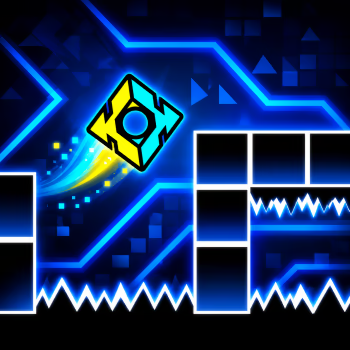
Geometry Jump is a fast-paced platform game that turns a simple jump into a challenge of precision and concentration. Guide a geometric character through colorful courses filled with sharp spikes, dangerous gaps, and obstacles that demand carefully timed movements.
Your character runs forward automatically, so there is no need to control its horizontal speed. Instead, your task is to recognize what lies ahead and choose the right moment to jump.
The game offers different difficulty settings, from accessible early challenges to demanding Extreme Hard and Endless stages. Every failed attempt gives you another opportunity to understand the course and improve your timing.
Your First Challenge: Learn When to Jump
Geometry Jump begins with a simple idea: avoid everything that can stop your character.
As the level moves forward, spikes, platforms, and other hazards appear along your route.
You must jump at the right moment to pass them safely.
Jump too early, and your character may land directly on an obstacle.
Jump too late, and you may collide with it before leaving the ground.
The safest approach is to watch the distance between your character and the next hazard.
Early attempts are useful for understanding how far your character travels during a jump.
Once you become familiar with that distance, you can start timing your movements more consistently.
Controls
Desktop
Mobile
Your character moves forward automatically.
The main challenge is choosing when to press and release rather than controlling the direction of travel.
Choose a Difficulty That Matches Your Skills
Geometry Jump provides several challenge levels that allow players to improve gradually.
Easy: A good starting point for understanding the controls and practicing basic jumps.
Normal: Introduces more demanding obstacle combinations that require better timing.
Hard: Challenges players with tighter spaces and more complicated sequences.
Extreme Hard: Designed for experienced players who can react quickly and maintain precise control.
Endless: Focuses on surviving for as long as possible instead of simply reaching a fixed finish line.
Starting with easier challenges can help you understand the game's movement before attempting more demanding courses.
As you improve, try increasing the difficulty rather than repeating only the levels you already know.
Single Spikes and Spike Groups Need Different Timing
Not every obstacle should be approached in the same way.
A single spike may require a relatively simple jump.
A group of spikes creates a different challenge because you must remain above the dangerous area long enough to clear it.
Before jumping, pay attention to the width of the obstacle.
If you jump too early, your character may descend before passing the final spike.
If you jump too late, you may hit the first one.
Try to identify a consistent takeoff point that gives you enough room to clear the entire group.
As the game becomes more difficult, these decisions must be made more quickly.
Learning to recognize obstacle shapes can help reduce the number of unnecessary failures.
The Landing Can Be More Dangerous Than the Jump
Players often concentrate on getting over an obstacle without thinking about where their character will land.
In Geometry Jump, the next hazard may appear immediately after the first.
A successful jump can still lead to a crash if your landing position leaves no room for the next movement.
For example, jumping over a row of spikes may place your character close to another obstacle.
If you are not prepared, you may have too little time to jump again.
Look beyond the obstacle directly in front of you.
Try to recognize whether the next section requires another jump, a short landing, or a different movement pattern.
Planning the landing is just as important as clearing the obstacle itself.
Read the Course Instead of Reacting at the Last Second
Geometry Jump rewards players who recognize patterns.
Some sections contain widely spaced hazards, giving you time to prepare.
Others place several obstacles close together, requiring a sequence of accurately timed jumps.
Instead of reacting only when a spike reaches your character, look farther ahead.
Notice whether the next section contains one obstacle or several.
Pay attention to the distance between platforms and the position of nearby traps.
After several attempts, familiar patterns become easier to recognize.
This allows you to prepare your next movement before the danger becomes immediate.
What Makes Hard and Extreme Hard Different?
As the difficulty increases, the game becomes less forgiving.
You may encounter tighter passages, faster movement, and more demanding obstacle arrangements.
These changes reduce the time available to make decisions.
A jump that works in an easier stage may need more accurate timing in a harder one.
At higher difficulty levels, consistency becomes especially important.
You need to repeat successful movements while avoiding small mistakes that can end a promising attempt.
Rather than trying to react faster to everything, focus on recognizing the layout earlier.
Better anticipation often makes difficult sections feel more manageable.
Endless Mode Tests Your Concentration
Endless Mode offers a different objective from stages with a fixed finish line.
Instead of concentrating on completing one course, you try to survive for as long as possible.
This creates a challenge where maintaining focus becomes increasingly important.
A strong beginning does not guarantee a successful run.
You must continue making accurate decisions as new obstacles appear.
Avoid becoming careless after passing several easy sections.
Maintain the same attention to timing even when the course temporarily seems less demanding.
The longer you survive, the more valuable consistent movement becomes.
Use Music to Develop a Steady Rhythm
Geometry Jump combines colorful visuals with energetic background music.
The soundtrack can help you maintain a consistent pace while navigating obstacles.
However, not every jump should be made simply because you hear a beat.
The position of the obstacles remains your most important reference.
Use the music to support your concentration while watching the course carefully.
After repeating a difficult section, you may begin associating particular musical moments with upcoming hazards.
This combination of visual memory and rhythmic timing can make repeated attempts more predictable.
Five Mistakes That Make Geometry Jump Harder
Jumping too early: Your character may land before clearing a wide obstacle.
Jumping too late: A spike can end your attempt before the jump begins.
Ignoring the landing area: You may clear one obstacle but immediately collide with the next.
Pressing randomly: Unplanned jumps make it difficult to build consistent movement patterns.
Watching only the character: Looking farther ahead gives you more time to prepare.
Attempting the hardest stages immediately: Learning the basic movement first can make advanced challenges less frustrating.
Correcting these mistakes is often more useful than simply repeating the same unsuccessful approach.
A Better Way to Practice Difficult Sections
When you repeatedly fail at the same obstacle, try changing only one part of your approach.
First, identify whether your jump begins too early or too late.
Next, choose a visual reference near the obstacle.
This might be the edge of a platform, the beginning of a spike group, or another recognizable part of the course.
Use that reference to time your next attempt.
If you fail again, make a small adjustment rather than changing your entire movement pattern.
Once you successfully pass the obstacle, try to repeat the same timing.
This process helps turn an unpredictable challenge into a movement you can perform consistently.
Geometry Jump vs. Geometry Dash
Geometry Jump and Geometry Dash share a similar foundation: automatic forward movement, geometric obstacles, and precise timing.
However, Geometry Jump places particular emphasis on short jumping challenges and difficulty-based progression.
Geometry Dash offers a broader set of movement forms and mechanics across its different versions.
If you enjoy learning obstacle patterns and improving through repeated attempts, both games provide rewarding challenges.
Geometry Jump is especially appealing when you want a straightforward test of timing without spending time learning complicated controls.
More Geometry Games to Explore
If you enjoy Geometry Jump, Geometry Dash Lite offers another rhythm-based platform challenge with memorable stages and increasingly difficult obstacles.
Geometry Dash Wave focuses on controlling a zigzag movement pattern through narrow passages.
Try Geometry Dash Press Start for a level that combines precise jumps with changing movement mechanics.
Geometry Dash Breeze 3D offers a different perspective on navigating geometric obstacles.
For a more demanding challenge, Geometry Dash Hairless Adventure tests your ability to maintain consistent timing throughout a difficult course.
Play Geometry Jump online for free and discover how far accurate timing, careful observation, and repeated practice can take you.